2026: The Challenge
Back to the main RF Innovation page | See projects from previous years
ARTS ● ACTIVISM ● CIRCULARITY
*Roskilde Festival and Roskilde University invite students to contribute to developing experimental and co-creative experiences for the participants at Roskilde Festival - a living laboratory. *
Use the Roskilde Festival to explore experiences in which art and culture invite participants to reflect on circularity, sustainability, and co-creation
Art and culture can take on various expression forms, e.g., architecture and technology. Sustainability is seen in its broadest sense, both in terms of social, environmental, economic, and cultural aspects. Solutions can be technical designs, process-oriented courses, games, workshops, etc., addressing questions like:
- How can we, in practice, perceive the four bottom lines of the Roskilde Festival sustainability concept: environment, social, art, and economics?
- How can we offer inclusive spaces and communities to participants with special needs, diverse cultural backgrounds, functional capabilities, and identities?
- How can we prevent abusive behaviour and encourage a supportive atmosphere?
- How can we support new friendships, such as through games, a room for reflection, or facilities for dancing?
Project formats:
The living laboratory will be located in the festival area called BAZAR. The intention of the BAZAR area is to offer an area where participants can rest or join various activities addressing sustainability and circularity. Your project should fit within one of the following three formats:
- As a permanent installation on a light pole. This format ensures you have power and a solid base to mount your installation on. It is expected that the installation works on its own and that you maintain it during the music period.
- As a temporary workshop/demo. It will be possible to present and experiment with workshops, installations, and demos in which you are present and facilitate the experience. Here, you are expected to unpack and pack into a storage container for each session you run.
- As pop-up projects. Suppose your projects allow you to create experiments around the festival or camping area. In this case, it is expected that the size of your project is easily portable by yourself (think in terms of a backpack with gear).
You are responsible for building, maintaining, staffing, and dismantling your project at the Roskilde Festival.
How to participate and important dates
We have a kick-off and a hackathon to help you mature your project for the final submission.
The following dates and deadlines are important to be aware of:
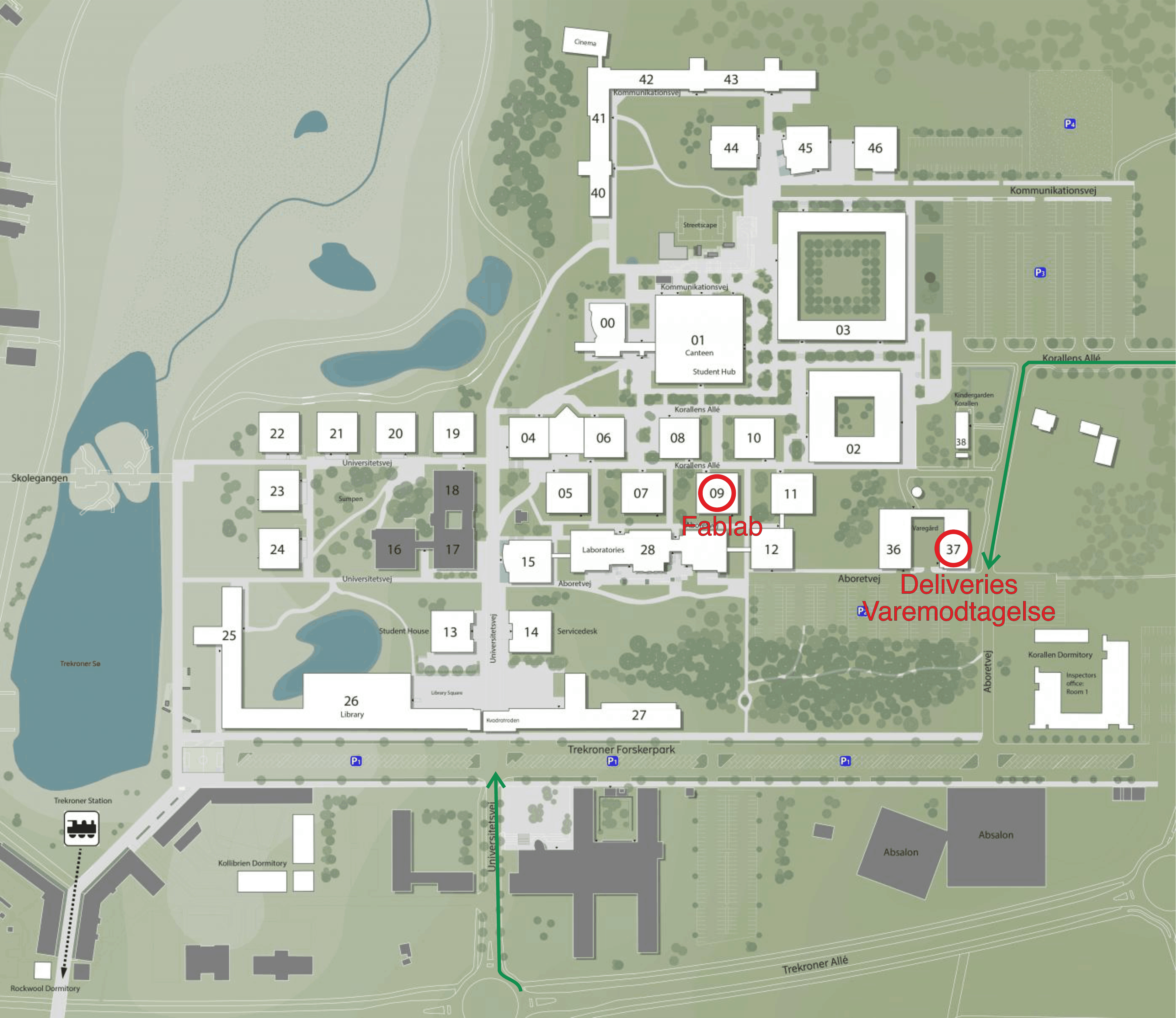
- 13 February: Kick-off - FabLab RUC: The kick-off will be a general introduction and a place to brainstorm and work on your ideas.
- 17 April: Hackathon - FabLab RUC: The hackathon is an entire workday where you can build your prototype in the FabLab and get feedback on durability. Finally, the finishing touches can be done in May at the FabLab.
- 21 April: Deadline for submission of applications to Roskilde Festival
Submit your application through this form
- 1 May: Notification of application
- 8-19 June: Project week in FabLab with technical support
- 22 June: 10-14 General test (generalprøve)
- 27 June: Opstart at Roskilde Festival
- 30 June: Reception and presentation of projects at Bazar (Probably at 15:30 – 17:00)
- 5 July: Take down at Roskilde Festival
Criteria for selection of projects
For your project to be considered for the Roskilde living laboratory, it needs to fit within the following criteria:
- It is an investigation in which you test and evaluate your idea at the festival.
- It creates a meaningful change for the participants during the festival.
- It is realistic and feasible for you to execute yourself.
- It uses reused/recycled materials.
- It reflects on sustainability in its broadest sense.
- A maximum of 4 people pr. project (or a really good argument and application for dispensation can be done).
This year we have a theme for the poles: The peaceful fantasy forest and its creatures.
To create a unified experience for Festival goers as they walk past the telephone poles in the main music area near the Orange stage, we have set a theme for the pieces to explore. For this year, the telephone poles have to work with the theme of “The peaceful fantasy forest and its creatures”. If you are going to use the poles for your project, we invite you all to design a piece that plays with this topic in the following ways:
Design something that is either a creature, critter, insect, etc., that lives in a peaceful fantasy forest, a tree, a cave (hule), etc. Or an experience for a person walking through the forest.
Reflect on a magical parallel, dreamy universe that creates interesting sensory experiences for participants to engage with.
Design something that invites slowness, reflection, togetherness and can be used as an alternative to the high intensity of music festivals in general.
Play with upcycled materials. Seek to create an upcycled aesthetic of bare PCBs and electronics.
Ensure the installation can be reused later by designing it to be modular and remountable. As we get closer to the Festival, we can help you make metal brackets, etc. So that the piece has a solid core structure.
Prioritise using the following materials (for uniformity): Metal, Neopixels, Upcycled electronics, Pex Pipe, Metal legs from tables (good for mounting to the pole) & acrylic.
If you have an idea that is not exactly within this theme, talk to us.
The selection committee consists of representatives from Roskilde Festival and Roskilde University.
Contact persons
Roskilde Festival:
Birgitte Rasmussen, birgitte.rasmussen@roskilde-festival.dk
Roskilde Universitet:
- Mads Hobye, Computer Science hobye@ruc.dk (academic)
- Nicolas Padfield, Fablab RUC nicolasp@ruc.dk (practical)
- Allan Grønbæk, Rektorsekretariat eksterne samarbejder allang@ruc.dk (collaboration, contracts etc.)